Steel Detailing Services: Why Accuracy Matters in Fabrication
Introduction
In structural steel projects, fabrication problems rarely start in the workshop. Most begin much earlier — during detailing — where small inconsistencies in drawings, dimensions, or connection information create costly issues during manufacturing and installation.
As projects get larger and more coordination-heavy, steel detailing has moved beyond basic drafting. It now sits at the center of keeping fabrication drawings, connection details, and installation workflows aligned throughout execution.
For fabrication teams, detailing accuracy directly affects production efficiency, material usage, installation sequencing, and coordination between disciplines. That’s why it’s become a standard part of how steel construction projects are run.
What Are Steel Detailing Services?
Steel detailing services involve preparing detailed drawings and fabrication models used to manufacture and erect structural steel components. These outputs give fabricators and site teams the exact information they need to produce and assemble steel correctly.
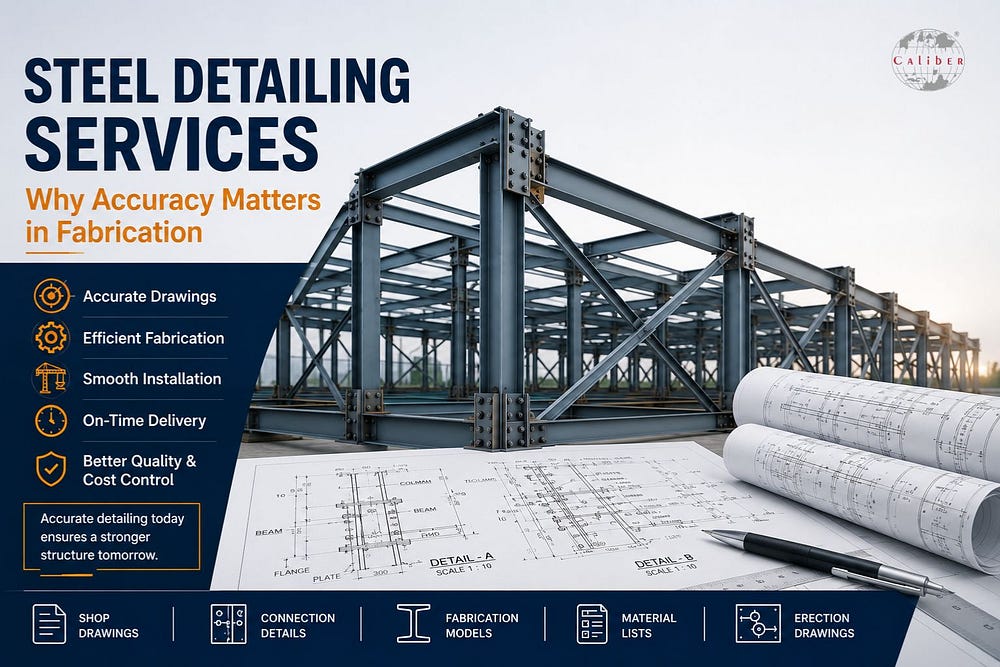
The process covers shop drawings, erection drawings, connection details, fabrication models, and material lists — all of which guide fabrication and installation teams during execution.
Structural design drawings focus on engineering calculations and structural performance. Steel detailing focuses on constructability: how components will actually be fabricated, connected, and assembled on-site. Every weld, plate, bolt, and connection has to be represented clearly so fabrication teams can work without ambiguity.
Why Accuracy Matters in Steel Detailing
Fabrication quality depends heavily on detailing accuracy. When drawings contain inconsistencies or coordination gaps, those issues usually surface during manufacturing or installation — when fixing them is expensive and disruptive.
Accurate detailing reduces fabrication errors, cuts rework on-site, improves installation efficiency, and keeps projects on schedule. It also improves coordination between structural engineers, fabricators, and erection teams by ensuring everyone is working from the same information.
On complex steel structures, even a small detailing error can create larger problems later in the workflow.
Role of Steel Detailing in Fabrication
Steel detailing bridges engineering design and physical construction. Structural engineers define the design intent; detailers translate that into fabrication-ready documentation that can be used directly during production and installation.
Fabricators rely on these drawings to manufacture steel components accurately. Erection teams use them to assemble structures correctly on-site. Without proper detailing, keeping design, fabrication, and installation aligned gets difficult.
This matters even more on projects where structural steel has to coordinate closely with architectural and MEP systems throughout execution.
Modern Steel Detailing Workflows
Steel detailing today is tied closely to digital construction workflows. Rather than relying entirely on 2D drafting, many projects now use coordinated 3D fabrication models to improve visibility and catch inconsistencies before fabrication begins.
This keeps fabrication drawings, connection details, and project requirements consistent while reducing coordination problems during installation.
Tools like Tekla Structures and AutoCAD are widely used for creating fabrication-ready steel models and detailed shop drawings. They improve precision and speed up coordination between detailing, fabrication, and construction teams.
Challenges in Steel Detailing
Despite better software and modeling workflows, steel detailing still requires careful coordination and solid technical understanding.
Projects often deal with frequent design revisions, tight fabrication schedules, incomplete information, and coordination gaps between disciplines. Keeping consistency across large-scale steel projects is hard without structured workflows and experienced detailing teams.
Handling these challenges well requires detailers who understand not just drafting standards, but fabrication processes and how construction actually runs on-site.
Role of External Steel Detailing Support
Many construction and fabrication companies work with external detailing teams to manage workloads and maintain consistency on complex projects. But in real fabrication environments, detailing isn’t just about producing drawings — it directly affects production timelines, installation sequencing, and coordination between teams.
Projects involving structural steel need workflows that stay aligned from detailing through fabrication and on-site execution. Companies like Caliber Tech Solutions work within these environments, supporting steel detailing, fabrication drawings, and coordinated modeling on projects where accuracy and constructability are critical. Their involvement helps keep detailing outputs aligned with fabrication requirements and installation workflows throughout the project.
For projects with complex fabrication environments, coordinated structural steel detailing workflows help maintain consistency between shop drawings, connection details, and fabrication models during execution.
Benefits of Professional Steel Detailing Services
Professional steel detailing improves both fabrication accuracy and construction efficiency. Coordinated drawings and fabrication-ready models reduce uncertainty before manufacturing begins, so teams can work with greater clarity during production and installation.
This leads to faster fabrication, better installation accuracy, fewer project delays, less material waste, and more predictable execution workflows.
Over time, these improvements give project teams stronger control over timelines, coordination, and construction quality.
Future of Steel Detailing
Steel detailing continues to develop alongside BIM and digital construction technologies. Model-based workflows, automation, and cloud collaboration are changing how detailing teams coordinate with fabrication and construction stakeholders.
The industry is gradually moving toward more connected environments where detailing, fabrication, and coordination work within shared digital workflows rather than isolated processes.
As structural steel projects grow more complex, the need for accurate and coordinated detailing will only increase.
Conclusion
Steel detailing plays a direct role in moving structural steel projects efficiently from design to fabrication and installation. Accurate detailing improves coordination, reduces execution problems, and maintains consistency throughout project stages.
In practice, the quality of detailing often determines how smoothly fabrication and installation run later on. As construction becomes more dependent on precision and coordination, steel detailing is no longer just a background activity — it’s central to getting projects delivered successfully.
FAQ: Steel Detailing Services
What are steel detailing services?
Steel detailing services involve creating fabrication and erection drawings for structural steel components used in construction projects.
Why is accuracy important in steel detailing?
Accurate detailing prevents fabrication errors, reduces rework, and improves installation efficiency during construction.
Which software is commonly used for steel detailing?
Tekla Structures and AutoCAD are widely used for steel detailing and fabrication modeling workflows.
What is the difference between structural design and steel detailing?
Structural design focuses on engineering calculations and structural performance, while steel detailing focuses on how components will be fabricated and assembled during construction.
What does a steel detailer do?
A steel detailer prepares shop drawings, connection details, fabrication models, and erection drawings that help fabricators and site teams manufacture and install structural steel accurately.
Why are shop drawings important in steel fabrication?
Shop drawings provide fabricators with precise dimensions, connection details, material specifications, and assembly information required for accurate manufacturing and installation.